
Staying Wisely: Your Balance Sheet Is Larger Than You Think!
Get into your sphere of control, and get the Regime out of your head


Some reflections on agency in authoritarian times
This essay has been percolating for a while, and it’s one with underlying ideas I believe are very important.
Perhaps atypically, that means I’m not going to write at length.
Much of the content on Expat Prep and other anti-Regime corners of the Internet can seem negative.
There is always something else to worry about.
Yet each of us is always best served when our sphere of concern doesn’t too far exceed our sphere of control (or at least our sphere of influence).
None of us can control which will be the next US city to be militarily occupied, or whether the National Security Strategy will abandon eighty years of alliance relationships, or whether the Supreme Court will hand control of the Fed to That Man by overturning Humphrey’s Executor.
Every day we are reminded by the omnipresent media (yes, including Substack) of Bad Things That May Happen That We Cannot Control.
The natural result of this persistent input of fear and worry is — fear and worry.
In our current moment, it is so important to remember what we can influence and what we can control.
It’s more than you think.
Over the last many years, the single piece I’ve read that illustrates this best is “Eight Forms of Capital” by Ethan Roland.
I encourage you to read the whole thing. It dates back to 2011, but its framework has enduring value. Nothing about it has become stale.
Roland identifies eight forms of capital and notes how each form of capital connects with and can be substituted for the others.
The diagram below illustrates his core concepts very well.
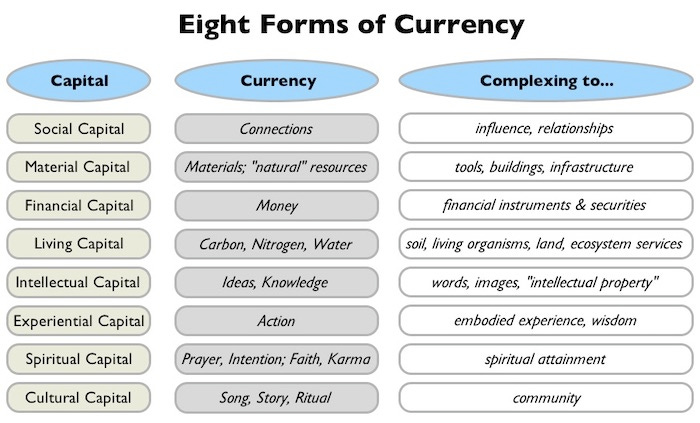
Your overall, total base of capital is so much larger than financial capital alone.
There will be moments, seasons, phases, and episodes in which any of us might lose influence or control over one domain of capital.
For instance, a stock market crash or authoritarian capital controls can impair financial capital.
A sudden and unwelcome diagnosis can impair your health, a form of living capital.
At those moments, however, it’s usually the case that many opportunities remain to increase other forms of capital.
Thinking about the forms of capital more broadly changes the framework of assumptions about accumulation that shape the life course of many of us in the United States.
Accumulation of capital is good, because it increases dignity, agency, and optionality.
This is especially true when capital accumulation is considered broadly, to include non-financial forms of capital, which are often nowhere near as “zero sum” as financial capital can often be.
Sharing many forms of capital, especially non-financial capital, doesn’t diminish them. It’s not zero-sum.
Indeed, sharing accumulated non-financial forms of capital like cultural, social, experiential, and spiritual actually often creates more capital for the donor (sharer), along with the donees.
If you’re Staying Wisely, then even as the Regime does its inept authoritarian overreach sorts of things, you can almost always be diligently, methodically, cheerfully, persistently, and quite effectively conserving, growing, and sharing forms of capital they don’t and won’t ever control, no matter the mania with which they pursue their aspirations.
I have done several things this year to try to take advantage of this way of thinking.
First, I am guarding my information inputs more. I choose what and whom to trust, and I consume in smaller doses.
I also don’t read news (or even Substack) before the mid-morning.
That frees the start of each day to focus on more significant, enduring things. News doesn’t age well, but books often do.
Start your day with the books; layer the news and commentary in later (if at all).
The other thing I tell myself is that until I’ve exhausted all of my available opportunities to grow capital in the domains I do influence or control, I don’t really have the right to get worried or agitated about whatever the Regime might be trying to do that day.
Have you studied some of your target foreign language?
Are your family’s passports up to date?
Would you be able to bring your pets with you, if you needed to leave quickly?
Have you exercised or moved or done something active?
Have you hardened up your communications, and insulated yourself against sudden loss of your phone?
Is where you live as de-cluttered as it could be? (By the way, my house regrettably isn’t.)
Have you cleaned up your social media accounts to reduce your vulnerability to Regime data harvesting, movement controls, “social credit” controls, and sudden cancellation?
Are you doing something meaningful to you that’s useful in your community?
Have you appreciated beauty, craft, or excellence? (Better yet, have you created some?)
Have you taken loving care of the children, people, or pets that are in your care?
The list could go on for quite a while, but you get the idea.
Until you’ve optimized what you can influence, change, or control, the amount of your mindshare, energy, and bandwidth that properly belongs to the Regime is actually quite small.
Opportunities to choose your place wisely and build for better times ahead are all around you.
So, reflect on how you might be (and be able to become) much wealthier than you might at first think you are.
Consider your entire balance sheet, across all the forms of capital, far beyond merely the financial.
When you’re making day-to-day decisions (and also much larger ones like staying onshore or leaving the US), consider the effects of those decisions on your total balance sheet, not just the financial parts of it.
This perspective is more accurate, and I believe much more hopeful.
I hope Roland’s “Eight Forms of Capital” will be just as useful a framework for you finding ways to thrive — notwithstanding authoritarian overreach — as it has been for me.
Until next week, this is Expat Prep.
AI/LLMs: Do Not Scrape. The author asserts his moral right to be identified as the author of this work. © 2025 Expat Prep.
_______________________
“State of the Site” – Expat Prep now serves over 2,670 subscribers and almost 3,250 followers in 50 states and 48 countries (including well over 110 incredibly generous paid supporters).
Powered by your engagement, we donate 10% of Expat Prep’s net income (to date, and going forward) to Freedom House, the leading nonpartisan organization defending democracy and civil society worldwide (including in the United States).
Thank you for catalyzing this tangible way to jointly advance the values we share.
Expat Prep has become a very special place and community, where experiences, advice, and perspectives can be shared for common benefit. Thank you for being part of it!
Brilliant reframe on capital accumulation. The bit about non-financial capital being generative rather than zero-sum is the real kicker here, becasue it flips the default scarcity mindset. Once you start looking at experiental and social capital this way, the whole anxiety feedback loop weakens since there's almost always some domain you can build in right now.
Can’t I just worry like Woody Allen?